Carpenter Ants in Your Home?
Identification, Damage and Professional Extermination in Quebec
Nest elimination – targeted treatment – 12-month guarantee
Seeing large ants inside your home?
Carpenter ants (Camponotus) are very common in Quebec and are among the most destructive insects found in houses. Unlike ordinary ants, they do not simply search for food: they excavate galleries in wood to establish their colony.
Over time, these galleries can weaken the structure of a building and cause significant damage.
If you regularly see large black ants inside your home, it is possible that a nest is already present within the structure.

Carpenter ant

Carpenter ant with wings
How to Identify Carpenter Ants
Physical characteristics
Carpenter ants are among the largest ants commonly found in homes.
Typical characteristics include:
-
large size (6 to 12 mm)
-
black or dark brown color
-
rounded abdomen
-
Workers often seen travelling alone or in small groups
Unlike termites, carpenter ants do not eat wood. Instead, they excavate wood to create smooth tunnels and galleries where the colony develops
Winged carpenter ants
At certain times of the year, usually in spring or early summer, you may see winged carpenter ants inside the house.
These reproductive ants are a strong indicator that a mature colony may already be established nearby


Signs of a Carpenter Ant Infestation
Several signs can indicate the presence of carpenter ants in a house
-
Large ants appearing indoors
Seeing carpenter ants inside the home, particularly at night or near food sources, is often the first warning sign of an infestation.
-
Sawdust or wood debris
Carpenter ants push out small piles of wood debris called frass from their galleries.
These piles may appear:
-
along baseboards
-
near window frames
-
in basements
-
under wooden structures
-
Noise inside walls
In severe infestations, faint rustling or crackling sounds may sometimes be heard inside walls as the ants expand their galleries
Where Carpenter Ant Nests Are Usually Located
Carpenter ant nests can be hidden in many areas of a property.
Common nesting locations include:
-
inside walls and insulation
-
inside wooden beams or structural lumber
-
in the attic
-
in damp or damaged wood
-
inside tree stumps
-
in trees close to the house
Many homes actually contain satellite nests, meaning several smaller colonies connected to a main nest.
Damage Caused by Carpenter Ants
Over time, carpenter ants excavate extensive networks of galleries inside wood structures.
These tunnels may be found in:
-
structural beams
-
floor joists
-
wall studs
-
door and window frames
-
wooden decks or exterior structures
If an infestation remains active for several years, the structural integrity of wood components may be affected.
Possible consequences include:
-
weakened wooden structures
-
sagging floors
-
structural repairs costing thousands of dollars

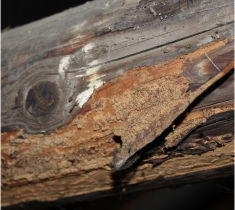

Damage caused by Carpenter Ants
Why DIY Carpenter Ant Treatments Often Fail
Many homeowners try to eliminate carpenter ants using products purchased from hardware stores. While this approach is understandable, it often does not solve the underlying problem.
The main nest is hidden
The ants you see inside the house are usually worker ants searching for food.
The main colony may actually be hidden:
-
inside a wall
-
in the attic
-
inside structural beams
-
in a nearby tree
As long as the main nest remains active, the colony continues to produce new ants.
Store-bought sprays can spread the infestation
Certain insecticides sold to the public can disturb the colony and cause carpenter ants to create multiple satellite nests inside the building, making the infestation more difficult to control.
Baits must be adapted to the season
Carpenter ants change their feeding preferences throughout the year. A bait that works well in spring may be ignored later in the season.
Professional pest control treatments adapt the bait strategy based on the ants’ current feeding behavior.
Why Early Treatment Is Important
Carpenter ant colonies can grow to thousands of individuals and may develop several satellite nests within a structure.
Improper treatments can:
-
relocate the colony deeper inside the building
-
create multiple secondary nests
-
prolong the infestation
A professional inspection helps identify the source of the problem and eliminate the colony more effectively.
When Should You Call a Carpenter Ant Exterminator?
You should consider professional inspection if:
-
you see carpenter ants daily inside your home
-
you notice winged ants indoors
-
you find sawdust or wood debris
-
ant activity increases in spring or early summer
A professional pest control intervention typically includes:
-
identifying areas of activity
-
locating the main nest and satellite nests
-
applying targeted treatment
-
implementing preventive measures to reduce future infestations
Carpenter Ant Inspection and Extermination in Quebec
If you suspect a carpenter ant infestation, a prompt inspection can prevent the colony from causing additional damage to the structure of your home.
Professional pest management allows the infestation to be controlled quickly and safely.
Call today to schedule an inspection
or
Fill out the contact form to receive a rapid call back.


Guêpe commune gros plan près d’une habitation
Guêpes autour d’un nid près d’une maison

Crottins de souris sous un évier de cuisine
Guêpe commune gros plan près d’une habitation
Mice or ants in your house ?
We offer fast professional treatments guaranteed 12 months
Fill out the contact form for a quick call back
Fill form and receive THE BEST pro tip as it pertains to your situation
